Home Energy Rebates by State
Some states have already opened Home energy rebates. You can receive up to $14,000 toward electric upgrades and up to $8,000 for whole-home savings. Discounts come from your State Energy Office, working through approved contractors and stores, and it also decides when the program launches.
- Heat Pump Rebate: Maximum Amount
- $8,000 The federal cap on space heating or cooling under HEEHR
- Electric Rebate Cap per Household
- $14,000 The most a household can receive in combined total under HEEHR
- Whole-Home Savings Rebate
- $8,000 The federal cap for low-income homes at 35% modeled energy savings
- The New Federal Rule Date
- May 29, 2026 The date gas-to-electric switching rebates ended under HEEHR
Home Energy Rebates by state
For both federal rebate programs, every state chooses its own rules and opening date.
| State | HEAR (appliances) | HOMES (whole home) | Program name | Source |
|---|---|---|---|---|
| Alabama | Not open yet | Not open yet | Inflation Reduction Act Home Energy Rebates Program | Source |
| Alaska | Approved, not open yet | Approved, not open yet | Alaska Residential Energy Rebates – High-Efficiency Electric Home Rebate | Source |
| Arizona | Open | Approved, not open yet | Efficiency Arizona (Home Electrification and Appliance Rebates, HEAR) | Source |
| Arkansas | Not open yet | Not open yet | Home Energy Rebates Program, covering Home Electrification and Appliance Rebates | Source |
| California | Paused | Not open yet | Home Electrification and Appliance Rebates | Source |
| Colorado | Paused | Approved, not open yet | Colorado Home Energy Rebate Program, covering Home Electrification and Appliance Rebates | Source |
| Connecticut | Not open yet | Not open yet | The Home Electrification and Appliance Rebate program (HEAR), which was formerly HEERA | Source |
| Delaware | Not open yet | Not open yet | Home Electrification and Appliance Rebate Program | Source |
| District of Columbia | Open | Open | Affordable Home Electrification Program | Source |
| Florida | Not open yet | Not open yet | High-Efficiency Electric Home Rebates | Source |
| Georgia | Paused | Open | Home Electrification and Appliance Rebates, under Georgia's Home Energy Rebates | Source |
| Hawaii | Approved, not open yet | Not open yet | The eHale Energy Saver pathway using High Efficiency Electric Home Rebates (HEEHR) | Source |
| Idaho | Not taking part | Not taking part | Home Energy Rebates (HEAR / High-Efficiency Electric Home Rebate Program) | Source |
| Illinois | Not open yet | Approved, not open yet | Illinois Home Electrification and Appliance Rebate Program | Source |
| Indiana | Open | Open | Indiana Energy Saver Program – Home Appliance Rebate (HEAR) | Source |
| Iowa | Not open yet | Not open yet | High-Efficiency Electric Home Rebates (HEEHRA / HEAR) Program | Source |
| Kansas | Not open yet | Not open yet | Kansas Home Rebates Program, covering Home Electrification and Appliance Rebates (HEAR) | Source |
| Kentucky | Not open yet | Not open yet | Kentucky Home Energy Rebates Program (appliance upgrade pathway) | Source |
| Louisiana | Not open yet | Not open yet | Home Electrification and Appliance Rebate (HEAR) Program (50122) | Source |
| Maine | Partly open | Not open yet | Home Electrification and Appliance Rebates | Source |
| Maryland | Not open yet | Not open yet | High-Efficiency Electric Home Rebate Program (HEEHR) | Source |
| Massachusetts | Not open yet | Not open yet | Home Electrification and Appliance Rebates | Source |
| Michigan | Partly open | Partly open | Michigan Home Energy Rebates | Source |
| Minnesota | Not open yet | Not open yet | The Home Electrification and Appliance Rebate (HEAR), which sits within Save Energy Minnesota | Source |
| Mississippi | Not open yet | Not open yet | Home Electrification and Appliance Rebates (HEAR) | Source |
| Missouri | Not open yet | Not open yet | High-Efficiency Electric Home Rebate (HEEHR) Program | Source |
| Montana | Paused | Paused | High Efficiency Electric Home Rebate | Source |
| Nebraska | Not open yet | Not open yet | High Efficiency Electric Home Rebate Program | Source |
| Nevada | Approved, not open yet | Approved, not open yet | Nevada's Home Electrification and Appliance Rebates Program under IRA section 50122 | Source |
| New Hampshire | Approved, not open yet | Not open yet | Home Electrification and Appliance Rebates (HEAR) Program | Source |
| New Jersey | Not open yet | Not open yet | High-Efficiency Electric Home Rebate (HEEHR) Program | Source |
| New Mexico | Partly open | Approved, not open yet | Home Electrification and Appliance Rebates (HEAR) | Source |
| New York | Partly open | Partly open | Home Electrification and Appliance Rebates | Source |
| North Carolina | Open | Open | The Home Electrification and Appliance Rebates (HEAR) offered by Energy Saver North Carolina | Source |
| North Dakota | Not open yet | Not open yet | Home Electrification and Appliances Rebates (HEAR) | Source |
| Ohio | Approved, not open yet | Approved, not open yet | High-Efficiency Electric Homes Rebate Program | Source |
| Oklahoma | Not open yet | Not open yet | HERRA / High-Efficiency Electric Home Rebate (HEEHR) Program | Source |
| Oregon | Not open yet | Not open yet | Oregon Home Electrification and Appliance Rebates Program | Source |
| Pennsylvania | Not open yet | Not open yet | High-Efficiency Electric Home Rebate (HEEHR), run under Penn Energy Savers | Source |
| Rhode Island | Partly open | Partly open | Home Electrification and Appliance Rebate (HEAR) Program | Source |
| South Carolina | Not open yet | Not open yet | South Carolina Home Electrification and Appliance Rebates (HEAR) | Source |
| South Dakota | Not taking part | Not taking part | Home Electrification and Appliance Rebates (HEAR) | Source |
| Tennessee | Not open yet | Not open yet | High-Efficiency Electric Home Rebate (HEEHR) Program | Source |
| Texas | Not open yet | Not open yet | Texas Home Energy Rebates, covering the Home Electrification and Appliance Rebate | Source |
| Utah | Paused | Paused | Utah Home Energy Rebates | Source |
| Vermont | Paused | Not open yet | Vermont Home Electrification and Appliance Rebate Program (HEAR) | Source |
| Virginia | Not open yet | Not open yet | High Efficiency Appliance Rebate (HEAR) program | Source |
| Washington | Not open yet | Not open yet | The Home Appliance Rebate Program (HARP), which is Washington's federal IRA HEAR program | Source |
| West Virginia | Partly open | Open | Home Efficiency Appliance Rebates (HEAR) | Source |
| Wisconsin | Open | Open | The Home Electrification and Appliance Rebates (HEAR), which Focus on Energy delivers | Source |
| Wyoming | Not open yet | Not open yet | High-Efficiency Electric Home Rebate Program | Source |
Hold off on buying equipment until your state program opens and you have reserved funds through an approved contractor.
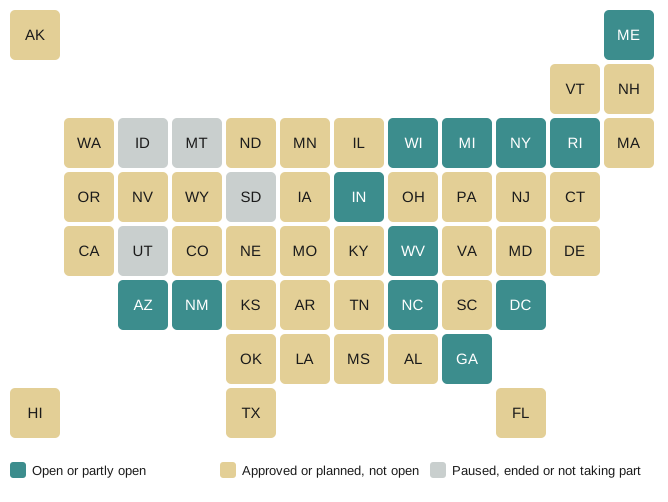
Get the data here: every state as CSV · SVG status map
Home Energy Rebates by State and National Status
Through September 30, 2031, federal law gives $8.8 billion to State Energy Offices so they can set up programs shaped to their state. According to the Department of Energy, select states now offer these IRA home energy rebates. Programs are open right now in Arizona, Indiana, Wisconsin, and the District of Columbia. For qualifying residents, Maine, Michigan, New Mexico, Rhode Island, and West Virginia run programs that are partly open. Applications are paused in California, Colorado, Georgia, Montana, and Vermont, either because funds were reserved or because rules changed. After state leaders turned down the federal money, South Dakota and Idaho are not participating. All the remaining states are still planning a launch or waiting on final federal approval before they take applications.
HEAR Rebate Heat Pump and Appliance Limits
Families earning less than 150% of the area median income, the middle income in your area, can get help under the High-Efficiency Electric Home Rebate. If your household earns under 80% of that local middle income, up to 100% of your project cost can be covered. Earning between 80% and 150% means up to 50% of your project cost can be paid. The combined total per household for your ENERGY STAR appliance rebate cannot go over $14,000, and each item has its own cap:
- Equipment for space heating and cooling earns an Inflation Reduction Act heat pump rebate of up to $8,000.
- Work on the main breaker panel, known as the electric load service center upgrade, earns as much as $4,000.
- Coverage runs up to $2,500 for new electric wiring in your house.
- A rebate of up to $1,750 is available for an electric heat pump water heater.
- Insulation, air sealing, and ventilation upgrades in your home pay up to $1,600.
New Rules for the DOE Home Energy Rebate Program
Program Notice 26-2, issued by the federal government on May 29, 2026, changed who qualifies for appliance rebates. The program name went back to High-Efficiency Electric Home Rebates under the same agency action. This rebate no longer covers a switch from gas, propane, or oil furnaces to electric heat pumps. Payments now cover only swaps of older electric systems for more efficient electric models, plus new home construction. Before heating and cooling upgrades are installed, homeowners must also put rebates toward insulation and air sealing. Active programs got three months to update their rules, and North Carolina set a September 1, 2026 deadline. Your state may honor a rebate reservation you already hold under the old rules, if it was approved.
Whole-Home Savings in the Home Energy Rebate Program
Any income level can join the Home Efficiency Rebates program, which pays for projects that lower a home's overall energy use. Modeled energy savings, meaning a computer estimate of the drop in your energy use before work begins, is what most states rely on. ENERGY STAR equipment can be made optional by states for these whole-home projects under Program Notice 26-1.
- Standard households that save 20% to under 35% get the lower of $2,000 and 50% of project costs.
- Standard households that reduce energy use by at least 35% receive 50% of costs or $4,000, whichever is less.
- Households that earn below 80% of the local middle income can have up to 80% of costs covered, with a cap of $4,000 or $8,000.
- Higher low-income caps exist under state-specific rules, up to $18,000 in Indiana and $20,000 in West Virginia.
How to Apply Through Your State Energy Office
These programs are managed by every state, territory, or Tribe, which also picks the products and contractors that qualify for funding. Appliance rebates apply at the point of sale, so the discount is taken right off your bill when you buy. To avoid missing out on your payment, follow these four steps:
- Confirm with your State Energy Office that applications are open before any equipment purchase.
- Your local income tier gets verified with your household tax returns or income documents, so have them ready.
- Choose a contractor approved by the state, who can then reserve your funds and put the upfront discount on your invoice.
- If you claim the electric heat pump appliance rebate, finish any required insulation and air sealing work first.
Common Questions About Home Energy Rebates
What home energy rebate opportunities does Ohio offer for 2026?
Its program application went in on November 12, 2024, and Ohio is now waiting for final federal approval before opening. When the Ohio program opens, energy efficiency retrofits can bring individual households $2,000 to $4,000. Whole-home retrofit funding of up to $400,000 is available to qualifying multifamily buildings in Ohio.
Does Colorado offer heat pump rebates in 2026?
On November 13, 2025, Colorado launched its single-family appliance rebate program, but two regions closed on August 1, 2026. In winter 2026, the Colorado Energy Office expects to launch the state's rebate programs for whole-home efficiency. Large multifamily buildings, manufactured homes, and mobile homes will all be included in that winter launch.
In Wisconsin, which home energy rebates can you get?
All $149 million in federal rebate funding has gone to Wisconsin, and both of its state programs are open right now. The whole-home program from Wisconsin Focus on Energy gives extra help to lower-income households earning below 80% of local middle income. Families that qualify can have 100% of their project cost covered, with a state cap of $10,000.
Under the measured savings path, who qualifies for home energy rebates?
The measured energy savings path is open to any household, or any portfolio of homes, that reduces actual energy use by 15% or more. Rather than rely on an upfront computer estimate, this option pays at a rate of $2,000 when energy use falls by 20%. A total of $225,000,000 in dedicated federal funding also went to Indian Tribes, letting them run appliance rebate programs that qualifying tribal households can use.
Is there a rebate if you swap a gas furnace for a heat pump?
No. Rebates for switching from non-electric furnaces to electric heat pumps ended under federal rules issued May 29, 2026. The appliance program pays only in two cases under Program Notice 26-2: replacing an existing electric system, or building a new home. A rule that kept 40% of program money for low-income households only was also removed by the federal government.
Get installer quotes that include your rebates
Most rebates on this page are paid through the installer or need the installer's paperwork, so the quote is where the money is settled. Tell us the ZIP code and what you want installed, and installers who work with these programs send a written price with the rebates taken off.